

💸 Worried about unexpected expenses?
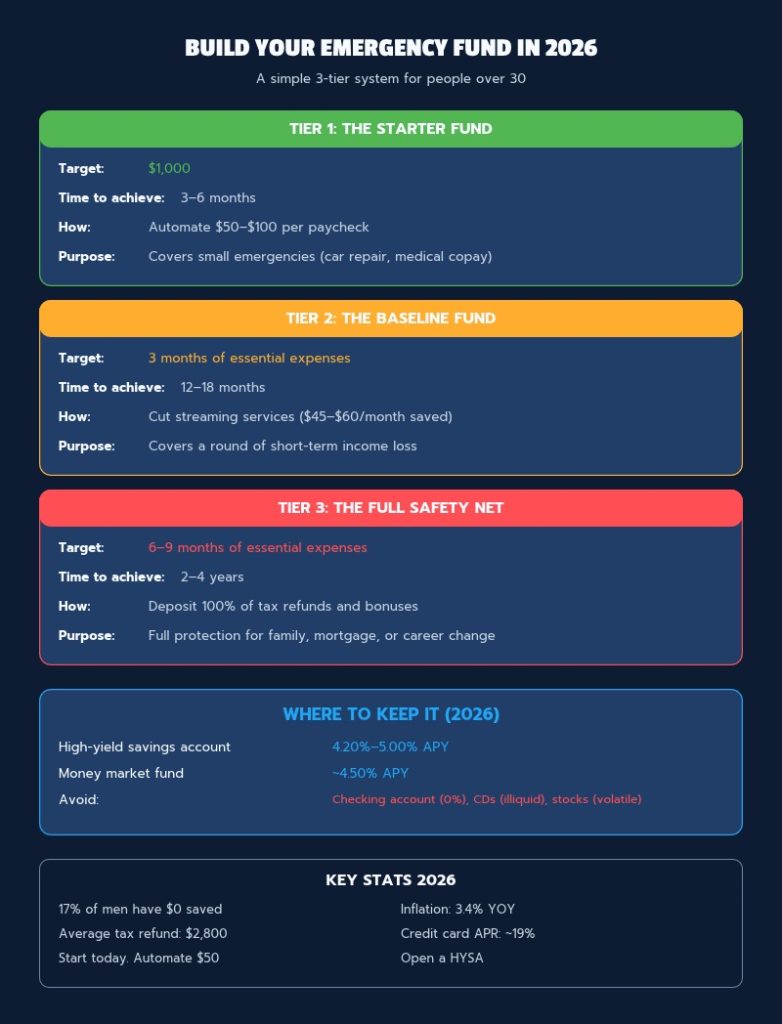
You’re not alone. In 2026, 17% of men have no emergency savings at all, and that number jumps to 22% for men aged 35–44. But here’s the good news: building a fund is simpler than you think. High-yield savings accounts are currently offering up to 5.00% APY, easily beating inflation at 3.4%. Start small: automate $100/month. Cut one subscription. Redirect a windfall. Aim for 3–6 months of expenses. Your future self will thank you.
#EmergencyFund #PersonalFinance #MoneyTips

Why an Emergency Fund Is Non-Negotiable in 2026
The economic landscape of 2026 rewards preparedness. Inflation has cooled from its 2022 peaks, but it remains sticky at 3.4% year-over-year as of August 2026. Meanwhile, one in four Americans still has zero emergency savings—the highest level ever recorded. For men over 30, the stakes are higher: career shifts, family obligations, and health surprises rarely announce themselves.
An emergency fund is not an investment. It is insurance against chaos. It prevents you from reaching for credit cards at 19% APR when your car dies or a layoff hits. It gives you the power to say “no” to bad opportunities and “yes” to calculated risks.
How Much Should You Save? (The 3–6 Month Rule)
The Baseline: 3–6 Months of Essential Expenses
Your first target is three to six months of essential living costs—not your full salary. Essentials include rent or mortgage, utilities, groceries, transportation, insurance premiums, and minimum debt payments. If your essentials run $3,000/month, your floor is $9,000.
Adjusting for Your Situation
-
Single, stable job, no dependents: 3 months is a reasonable floor.
-
Married with kids or a mortgage: Aim for 6–9 months.
-
Freelancer or commission-based: 9–12 months is prudent.
-
High-demand skill set: You can lean toward the lower end.
Where to Keep Your Emergency Fund in 2026
High-Yield Savings Accounts (HYSA)
HYSAs remain the gold standard. As of September 2026, top accounts are paying between 4.20% and 5.00% APY. That means $10,000 earns roughly $420–$500 per year while staying fully liquid and FDIC-insured. SoFi, American Express, and NexBank are among the consistent leaders.
Money Market Funds
If you want slightly higher yields and don’t mind a 1–2 day settlement period, money market funds from brokers like Vanguard or Fidelity are viable. They are not FDIC-insured, but they invest in ultra-safe short-term government debt. Yields often track the HYSA market closely.
Avoid: Checking accounts (near 0% interest), CDs (illiquid for true emergencies), and brokerage accounts (subject to market swings).
How to Build Your Fund Faster
- Automate Your Savings: set a recurring transfer from checking to your HYSA on payday. Even $50 per paycheck builds momentum. Automation removes willpower from the equation.
- Cut Non-Essential Expenses: audit your subscriptions. The average American spends **$219/month on streaming services alone**. Cutting three services frees up $45–$60 monthly. Redirect that directly to savings.
- Use Windfalls: tax refunds, annual bonuses, birthday cash, and side-gig income are accelerators. Deposit 100% of them into your fund until you hit your target. The IRS reports the average refund in 2026 is around $2,800—that’s nearly a full month of expenses for many households.

Common Mistakes to Avoid
-
Investing your emergency fund in stocks. A market crash coincides with layoffs. You need cash, not a fire sale.
-
Using the fund for non-emergencies. A “sale” is not an emergency. A vacation is not an emergency. Define “emergency” in advance: job loss, medical bill, urgent home or car repair.
-
Keeping it in your checking account. You will spend it. The friction of a separate account is a feature, not a bug.
-
Waiting for the “perfect” time. Start with $500. Then $1,000. Then one month. Progress beats perfection.
Keep in mind!
An emergency fund is the foundation of every other financial goal. Without it, debt reduction, investing, and retirement savings all rest on a shaky floor. In 2026, the tools are better than ever—5% APY is available with zero risk.
The only missing piece is your decision to start. Open an HYSA today, automate $50, and let time do the rest.